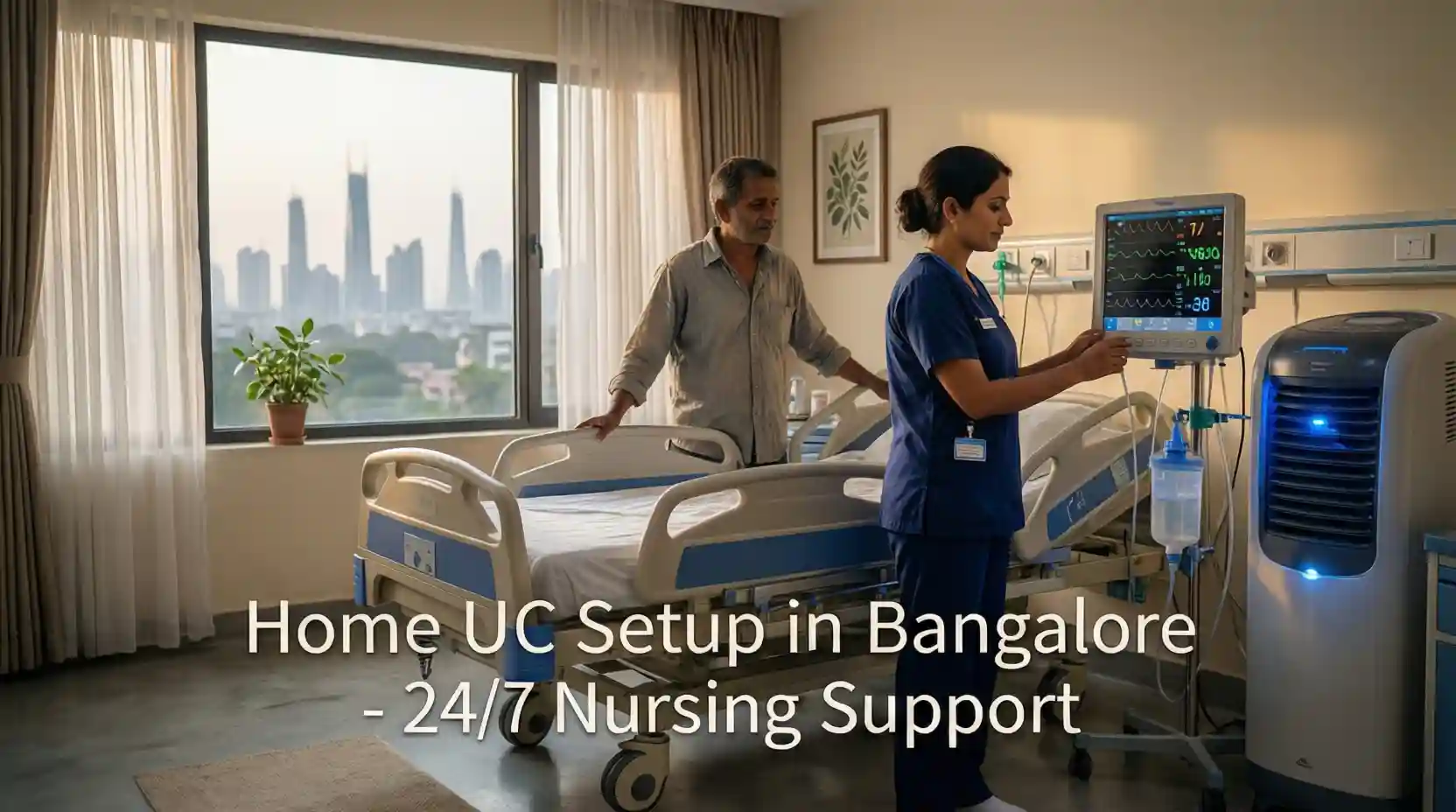
1-MINUTE READ SUMMARY
ICU at home Bangalore offers hospital-level care at home with ICU-grade equipment, continuous vital monitoring, and 24-hour nursing care for patients who can be safely managed at home.Home ICU is often 40% to under 50% cheaper than a hospital ICU stay and may also reduce exposure to hospital-acquired infections, which are common in ICU settings.This Spandhana Public Trust guide explains who home ICU suits, how setup and staffing work, and the safety checks to keep critical care at home reliable and affordable.

INTRODUCTION
When your elderly parent or loved one needs intensive care, the idea of staying in a hospital ICU for weeks can feel scary, tiring, and costly. Many families also worry about infections in hospitals and the stress of being away from home during a hard time.
That is why ICU at home Bangalore is becoming a practical option for some patients. ICU at home in Bangalore means hospital-level care at home Bangalore, with ICU-style monitoring, trained nurses, and the right equipment arranged at your home. It can support Critical care at home Bangalore needs like post-ICU recovery, Elderly critical care at home, ventilator or oxygen support (as advised by the doctor), and Bedridden patient care at home with close supervision.
This matters more now because Karnataka’s older population share is expected to rise (one government report notes an increase from 8.9% in 2016 to 13.3% by 2026, with Karnataka around 9.71% in 2016). At the same time, ICU bills can climb quickly private hospital ICU charges in India are often quoted around INR 15,000 to INR 30,000 per day, and longer stays raise costs further. Home-based healthcare has also grown after COVID, with industry reports describing how home care expanded to include acute and even critical care at home.
What you’ll learn in this guide:
- How ICU at home works and who it is suitable for.
- Equipment and setup needed for safe home ICU care.
- Costs vs. hospital ICU care (and what changes the price).
- Safety steps, monitoring, and what to do in emergencies.
This guide is for Bangalore families caring for elderly parents, bedridden patients, or loved ones needing post-hospital critical care who want a safe, affordable, and dignified alternative, with support from Spandhana Public Trust.
What is ICU at Home and How Does It Work?
What is ICU at home care? It is a complete medical service that brings ICU-style support into your house, so a patient can get hospital-level care without staying in a hospital for long days. In simple words, ICU at home Bangalore combines the right equipment, trained staff, and close monitoring so care feels organised, safe, and respectful for the patient and family.
Here’s how it usually works. First, a doctor checks if the patient is stable enough for home ICU (this is very important). Then a care plan is made based on the illness what to monitor, what medicines to give, and what to do if something changes. Next, the needed devices are set up at home (like oxygen support, monitors, suction, or a ventilator if prescribed), and home-based intensive care nursing is arranged, often as 24-hour shifts. Doctors may visit on schedule, and some follow-ups can happen through phone/video calls when suitable.
Key Components of Home ICU Care
Core services can include breathing support, IV medicines and fluids, wound care and bedsore prevention, catheter and tube-feeding care, physiotherapy/rehab, plus family training and counselling for daily handling.
Who Manages Your Care at Home?
A supervising doctor leads the plan, ICU-trained nurses handle round-the-clock care, and there are emergency steps in place with quick hospital coordination if the patient needs transfer.
Spandhana Public Trust has been providing expert home nursing services since 2001, supporting Bangalore families with critical care setups and trained caregivers.
What Medical Equipment Does ICU at Home Require?
Setting up a home ICU needs the right medical equipment, and the exact items change based on the patient’s condition, doctor advice, and risk level. Still, most ICU-at-home setups use a standard set of tools for breathing support, continuous monitoring, and safe nursing care. This is also where Home ICU setup costs can vary because adding advanced support (like ventilator care) usually means more devices and higher staffing needs.
What equipment does ICU at home require? Here are the common essentials:
- Ventilator/BiPAP machine: For patients who need breathing support; comes in portable or fixed models and often uses a humidifier.
- Cardiac/Patient monitor (para monitor): Tracks heart rate, BP, oxygen level (SpO2), and breathing rate; alarms alert the nurse to unsafe readings.
- Oxygen supply system: Oxygen concentrator for regular use, plus cylinder backup; includes flow meter and humidifier bottle.
- Suction machine: Clears mucus/secretions; very important in Home ventilator care services.
- Infusion/Syringe pump: Gives IV medicines and fluids in exact doses and speed.
- Hospital-grade bed: Electric ICU bed with side rails; anti-bedsore (anti-decubitus) mattress.
- Monitoring devices: Pulse oximeter, BP monitor, digital thermometer, glucometer.
- Support equipment: Nebulizer, IV stand, bedpan and urine collection, DVT pump (for leg circulation).
- Hygiene & safety supplies: Gloves, masks, PPE kits, disinfectants, sanitizers, and basic emergency medicines (as prescribed).
Spandhana Public Trust can arrange the full home ICU setup with required equipment, so families don’t have to run around renting or buying items separately. This reduces delays and helps you focus on the patient’s comfort and recovery.
How Much Does ICU at Home Cost in Bangalore? [Complete Price Breakdown]
ICU at home in Bangalore can cost much less than a long hospital ICU stay often reported as 40–50% lower which makes critical care possible for more families. The biggest reason is simple: at home, you mainly pay for the nurse, the required machines, and the planned doctor support, instead of paying for full hospital ICU infrastructure every day.
Here is a clear, practical estimate many families use while planning:
| Service component | Typical monthly cost range (Bangalore) | Hospital ICU equivalent |
|---|---|---|
| ICU-trained nurse (24-hour) | ₹50,000 – ₹78,000 | Usually bundled into ICU daily charges |
| Medical equipment rental | ₹15,000 – ₹35,000 (depends on what’s needed; e.g., ventilator rent can start around ₹12,000/month, oxygen concentrator rent around ₹4,500/month) | Included in daily ICU package (monitors, ventilator, pumps, oxygen, etc.) |
| Doctor consultations | ₹5,000 – ₹15,000 (example: 4–10 visits/month at ₹800–₹1,500 per visit) | Included but limited, and still part of the overall ICU billing |
| Medications & consumables | Variable (often ₹10,000 – ₹30,000+) | Variable; drugs, consumables, and routine investigations are part of ICU costs |
| Total monthly cost (estimate) | ₹80,000 – ₹1,50,000 (varies by condition and equipment) | Roughly ₹4,50,000 – ₹9,00,000+ per month if ICU charges are ₹15,000–₹30,000/day |
Cost factors that change your final bill:
- Patient’s condition complexity and how stable they are day-to-day.
- Type/number of machines required (especially home ventilator care services).
- Skill level needed (general nurse vs. ICU-trained nurse).
- Medicines, disposables, and how often doctor reviews are needed.
Why is home nursing cheaper than hospital ICU? Hospitals must cover ICU infrastructure maintenance, advanced equipment upkeep, sterilisation systems, and round-the-clock facility operations in their daily ICU rates, while home care focuses on only the patient’s direct needs.
Is ICU at Home as Safe as Hospital Care in Bangalore?
Yes ICU at home can be safe for patients who are medically stable, have crossed the “acute” (danger) phase, and mainly need ongoing intensive monitoring and skilled nursing at home. If you’re asking “What is ICU at home and is it safe?”, the real answer is: it’s safe when the right equipment, ICU-trained staff, and clear emergency rules are in place.
Safety measures in a good home ICU setup usually include:
- 24-hour nursing care Bangalore: ICU-trained nurses watch vital signs, give medicines on time, manage tubes/catheters, and respond quickly if the patient worsens.
- Continuous monitoring: Patient monitors and alarms help catch low oxygen, abnormal heart rate, or BP changes early.
- Regular medical supervision: Doctors review progress through planned visits and on-call support (often by phone/video when suitable).
- Emergency protocols: A written action plan, fast ambulance access, and coordination with a nearby hospital for quick transfer.
What happens if there’s a medical emergency at home ICU? The nurse starts first response (oxygen support, suction, positioning, emergency medicines only if prescribed) and immediately alerts the doctor and arranges hospital transfer when required.
When hospital ICU is better: unstable vital signs, active bleeding, sudden shock, need for emergency surgery, or frequent CT/MRI needs.
A key benefit at home is reduced exposure to hospital-acquired infections and antibiotic-resistant germs, which are known risks in ICU environments.
Who is Eligible for ICU at Home Care? Patient Conditions & Requirements
Not all patients who need intensive care must stay in a hospital ICU. Home ICU care is usually best for people who are medically stable (no active crisis) but still need close watching, skilled nursing, and ongoing treatment support at home.
What conditions require ICU at home care? Many families choose ICU at home for:
- Post-ICU recovery at home: Patients discharged from ICU who still need monitoring, oxygen/respiratory support, or ventilator “weaning” (slowly reducing support under medical guidance).
- Bedridden patient care at home: Patients who cannot move much and need turning, tube care, catheter care, and bedsore prevention with nursing supervision.
- Elderly critical care at home: Seniors with multiple health problems who need regular checks and consistent care in a calm home setting.
- Neurology cases: Yes, home ICU care may be suitable for stroke or dementia patients if they are stable but have complications like feeding tube needs, infections risk, or poor mobility (final decision should come from the treating doctor).
- Long-term ventilator/tracheostomy support: Patients who need respiratory support at home with trained nursing and monitoring.
Medical requirements for eligibility
- Doctor’s approval with a clear care plan and goals.
- Stable vital signs and predictable care needs.
- A suitable home setup (space, power backup plan, hygiene) and family cooperation.
Who may not qualify: patients in acute crisis, with unstable breathing/heart function, or those needing rapid emergency procedures or immediate surgical access.
Benefits of Choosing ICU at Home Over Hospital ICU
Choosing between a hospital ICU and a home ICU is a big decision, and it should be made with the treating doctor’s approval and a clear safety plan. For medically stable patients, home-based critical care can give strong benefits beyond cost comfort, fewer outside exposures, and more personal attention.
What are the benefits of home-based critical care, and why do families prefer ICU at home in Bangalore?
- Emotional comfort: The patient stays in a familiar room, and family can be close all day, which often reduces fear and stress during recovery.
- Lower exposure to hospital germs: ICU patients face higher infection risks in hospitals (one ICU study reported hospital-acquired infections in 38% of patients), so home care can reduce exposure to multi-patient environments.
- Cost-effectiveness: ICU at home is often reported to cost 40–50% less than hospital ICU care, which helps families plan better and avoid financial shock.
- One-on-one attention: A dedicated nurse at home focuses on one patient, with continuous monitoring and timely responses.
- Family training: Families can learn safe basics (positioning, feeding support, hygiene checks) and feel more confident after professional care ends.
When is ICU at home better than hospital care? It is usually better after the crisis phase, while hospital ICU is better for unstable patients who may need sudden procedures.
| Point | Hospital ICU | Home ICU |
|---|---|---|
| Infection exposure | Higher ICU infection burden reported in studies | Lower exposure to multi-patient setting |
| Cost | Higher overall ICU billing | Often 40–50% lower |
| Nursing attention | Nurse may manage multiple tasks/patients | One patient focus with 24/7 care |
How to Set Up an ICU at Home in Bangalore Step-by-Step Guide
Setting up ICU at home in Bangalore is a planned process medical approval first, then the right equipment, and then skilled nursingusually coordinated by a professional provider. If you are thinking, How do I arrange home ICU care in Bangalore?, these steps will help you move forward with fewer delays and fewer mistakes.
1: Medical Assessment & Doctor Approval
Meet the treating doctor and confirm the patient is fit for home ICU (meaning the patient has passed the emergency phase and can be managed with monitoring and nursing at home). Ask for a written care plan: diagnosis, current medicines, oxygen/ventilator needs, diet/feeding plan, and warning signs to watch.
Timeline: 1–2 days (often faster if the patient is already planned for discharge).
2: Contact Home Healthcare Provider
Call a trusted provider and share the latest discharge summary, current vitals, and required support (oxygen, suction, IV medicines, tube feeding, etc.). Most homecare teams can start services within 24–48 hours depending on the case and availability.
Timeline: Same day to 24 hours.
3: Home Environment Assessment
A nurse/technician checks if your home can safely support ICU care space for bed and monitor, clean area, ventilation, and easy access for staff and equipment. They also confirm practical needs like stable electricity for devices.
Timeline: 1–2 hours during the visit.
4: Care Plan Finalization
The provider aligns the home plan with the doctor’s plan and finalizes what equipment is needed (for example, ventilators, oxygen concentrators, monitors, infusion pumps). Nursing hours are also finalized (24-hour vs 12-hour), along with emergency contacts and escalation steps.
Timeline: Around 1 day.
5: Equipment Installation
Equipment is delivered, installed, and tested so alarms, readings, and backup support work correctly. Many setups also include real-time monitoring with alerts to the medical team for quick action when something changes.
Timeline: About 4–6 hours for installation and checks.
6: Nursing Staff Deployment
ICU-trained nurses begin care, check baseline vitals, set routines, and manage medicines and devices safely. This is where affordable critical care becomes “real” at home someone skilled is watching the patient, not just the machines.
Timeline: Immediate once the start time is confirmed.
7: Patient Transfer (if from hospital)
If the patient is coming from a hospital, the provider coordinates a medically supported transfer so the move is safe and smooth.
Timeline overview: In many cases, a complete setup can be arranged within 24–48 hours from first contact (sometimes faster for urgent needs).
At Spandhana Public Trust, we handle the full setup from equipment coordination to nurse deployment so families can focus on the patient, not the logistics.
How to Care for Bedridden Patients at Home [Essential Care Tips]
While professional ICU-trained nurses handle medical care, family members play a huge support role in bedridden patient care at home. Your help can improve comfort, prevent problems, and keep your loved one emotionally strong especially in elderly critical care at home where small daily care habits make a big difference.
Here are the essential care tips families can follow (always align with the nurse/doctor’s plan):
- Preventing bedsores (pressure ulcers): Reposition the patient at least every 2 hours, use an anti-bedsore (anti-decubitus) mattress if advised, keep skin clean and dry, and check common pressure points (back, hips, heels, elbows) daily for early redness.
- Maintaining hygiene: Give a gentle sponge bath daily, do oral care twice a day, keep nails trimmed, and change bedding often so it stays clean and dry.
- Nutrition & hydration: Follow the prescribed diet plan, offer small frequent meals (if the patient eats by mouth), track fluids, and report swallowing trouble (coughing during meals, wet voice, repeated choking) to the nurse immediately.
- Mobility & physiotherapy: Help with passive range-of-motion exercises taught by the physiotherapist or nurse to reduce stiffness and improve circulation.
- Bowel & bladder management: Do catheter care only as trained, maintain a regular bowel routine, and watch for infection signs like fever, foul smell, burning, or cloudy urine.
- Emotional & mental stimulation: Talk often, play familiar music, read short stories, and keep the patient involved in family life as much as possible.
- Monitoring & documentation: Maintain a simple care log (food, water, urine/stool, sleep, skin changes, pain, and any unusual symptoms) and share it with the nurse.
Family training matters: Spandhana nurses train families in basic, safe techniques so everyone can support the patient confidently and consistently.
Transitioning from Hospital to Home ICU Care What to Expect
How to transition from hospital to home ICU care is mostly about planning so the patient stays safe and there is no gap in treatment during post-ICU recovery at home. A good home ICU provider will help align the doctor’s plan, nursing plan, and equipment plan before the patient leaves the hospital.
Pre-discharge planning
- Hospital coordination: Speak with the hospital team about discharge eligibility, collect a clear discharge summary, medication list, diet/feeding instructions, wound care notes, and follow-up dates.
- Medical readiness: Doctors often look for stable vital signs for 48–72 hours, no active complications, a fixed medicine routine, and oxygen needs that can be safely managed at home.
Home preparation (ideally before discharge):
- Contact Spandhana Public Trust early so the home can be assessed, the home ICU setup can be completed, and nurses can be briefed on the case.
- Equipment is installed and tested, and family training is done for basic support tasks.
Discharge day:
- Hospital staff hands over to the home nursing team, records are shared, and a monitored ambulance transfer is arranged if needed.
First 48 hours at home:
-
ICU nurses watch closely, routines settle in, and a doctor review (call or visit) is planned.
Most families need about 3–7 days to fully adjust, and comfort often improves within the first week.
Understanding Nursing Qualifications for Home ICU Care
The quality of home ICU care depends a lot on the nurse’s training, because in 24-hour nursing care Bangalore, the nurse is the first person to notice danger signs and act fast. If you’re asking, “What qualifications do home ICU nurses need?”, focus on education, ICU experience, and emergency skills not just years in service.
Required nursing qualifications:
- Educational background: GNM (General Nursing & Midwifery) or BSc Nursing, valid Nursing Council registration, and usually 2–3+ years of hospital clinical experience (more is better for critical patients).
- ICU-trained nurse requirements: ICU/CCU ward experience, critical care training/certification, comfort with ventilator monitoring, and strong knowledge of emergency response steps (CPR basics, airway safety, oxygen support).
- Technical skills: Safe IV medication handling, reading patient monitor values, tracheostomy/tube and catheter care, suctioning, wound dressing, and infection-control routines.
- Soft skills: Calm communication with family, ability to work independently, quick decision-making, and respectful care.
Critical Care Equipment Maintenance & Troubleshooting
Reliable medical equipment home ICU is the backbone of safe ICU-at-home care, because machines like monitors, oxygen support, and suction are used continuously in home critical care plans. Good maintenance and quick troubleshooting reduce panic and help your nurse focus on the patient, not the device.
Equipment maintenance protocol:
- Daily checks (by nursing staff): Ventilator/BiPAP power-on self-check; confirm monitor readings and alarms; verify oxygen source level and flow; test suction machine; check battery/plug points; wipe high-touch surfaces; clean/replace filters if needed.
- Weekly maintenance: Deep cleaning as per device manual; replace consumables (tubing, filters, humidifier parts if used); run system diagnostics; confirm calibration; update a simple maintenance log.
Emergency backup systems to keep ready
- Backup oxygen cylinder in the house and easy to reach.
- Power backup (UPS/inverter: a battery backup for electricity) for critical devices.
- Manual ventilation bag (Ambu bag: hand pump used if a ventilator stops).
- Basic spare parts where applicable (tubing, sensors, connectors).
- 24/7 technical help contact for 24-hour nursing care technical support.
| Issue | Quick solution | Prevention |
|---|---|---|
| Power failure | Switch to UPS/inverter; move to charged battery mode | Daily battery checks |
| Low oxygen | Switch to backup cylinder; inform nurse/doctor | Monitor levels routinely |
| Monitor alarm | Recheck sensor/lead connections | Routine cleaning and checks |
| Ventilator malfunction | Start manual ventilation; call support/ambulance if needed | Daily function test |
Long-Term Care Planning: How Long Can ICU at Home Continue?
Home ICU care can continue as long as it is medically needed this may be a few weeks, several months, or even longer for some chronic cases. If a patient needs long-term breathing support and is stable, it may be possible to use a ventilator at home with the right care setup and training.
What affects the duration?
- Medical condition: Acute recovery may need short-term intensive support, while chronic illness support can last longer, and palliative care can continue as long as comfort-focused care is needed.
- Recovery milestones: Less oxygen support, stable vital signs, fewer IV medicines, better swallowing/feeding tolerance, and safer mobility usually mean the care level can be reduced.
- Ventilator dependency: Time on a ventilator varies widely (it can be hours, days, weeks, or longer depending on the reason).
Care level transitions (a common planning approach):
- Week 1–2: ICU-level monitoring and frequent nursing interventions.
- Week 3–6: Monitoring may slowly reduce if the patient stays stable.
- Month 2–3: Many patients shift to skilled nursing and rehab focus.
- Beyond 3 months: Some move to attendant care or more independent routines, if recovery allows.
Long-term critical care costs can become easier to manage when families plan for negotiated packages, and equipment rental/maintenance is often bundled into monthly arrangements rather than repeated daily hospital billing.
Exit strategy planning should include regular doctor reviews, a step-down plan to less intensive home care, and clear follow-up appointments so discharge from home ICU feels safe, not sudden.
FAQs About ICU at Home in Bangalore: Your Questions Answered
1) Is ICU at home as safe as hospital care in Bangalore?
Yes, ICU at home can be safe for medically stable patients who have already crossed the “emergency” phase and mainly need close monitoring and skilled nursing. Safety comes from 24/7 ICU-trained nursing, continuous vital checks on monitors, and a clear plan for what to do if readings change suddenly. Home care can also reduce exposure to hospital-acquired infections seen in ICU settings. If the patient is unstable or may need emergency surgery, hospital ICU is safer.
2) How much does ICU at home cost compared to hospital ICU in Bangalore?
In many cases, ICU at home is reported to cost about 40–50% less than a hospital ICU stay. A practical planning range is around ₹80,000–₹1,50,000 per month for home ICU, while hospital ICU can run much higher when daily ICU charges are added across a full month. Major cost parts include 24-hour ICU nursing, equipment rental (like ventilator and oxygen support), plus medicines and consumables. Final cost depends on the patient’s condition and equipment needs.
3) What medical equipment is needed for home ICU setup?
A safe home ICU setup usually includes a patient monitor (to track pulse, BP, oxygen, breathing rate), oxygen support (concentrator with cylinder backup), and a suction machine for airway clearing. If prescribed, a ventilator or BiPAP is added for breathing support. Many setups also use infusion/syringe pumps for controlled IV medicines and an adjustable hospital bed with anti-bedsore support. Small devices like pulse oximeter, BP monitor, thermometer, and nebulizer are also common.
4) Can a bedridden elderly patient be cared for at home with ICU support?
Yes bedridden patient care at home can work well when the patient is medically stable and the care plan is clear. ICU support at home helps with regular monitoring, oxygen/respiratory support if needed, tube or catheter care, and strict routines to prevent bedsores and infections. It also allows elderly critical care at home with family nearby, which many families value for comfort and dignity. The doctor’s approval is the key step before choosing home ICU.
5) What qualifications do home ICU nurses need?
For home ICU, look for a nurse with proper nursing education and valid registration, plus real ICU/CCU experience. ICU-trained nurse requirements usually include confidence with ventilator or oxygen support (if used), patient monitors, suctioning, IV medicines, and emergency first response skills like CPR basics. Choose 24-hour nursing care Bangalore services where the nurse can explain readings in simple words and document changes clearly. Also check background verification, shift handover quality, and whether one nurse focuses on one patient during duty hours.
6) How long can a patient stay on home-based ICU care?
Home ICU care can continue as long as it is medically necessary weeks, months, or longer depending on recovery and goals of care. Post-ICU recovery at home timeline is different for each patient: some step down quickly as oxygen and monitoring reduce, while others need longer support for chronic conditions. If someone is stable but needs long-term ventilation, it may still be possible to go home on a ventilator with the right setup, training, and follow-up. Ventilator duration can vary widely based on the illness and response.
7) What happens if there’s a medical emergency during home ICU care?
A well-run home ICU service works with a pre-made emergency plan. The nurse gives immediate first response (for example, checking airway, oxygen support, suctioning, and urgent vitals), and contacts the on-call doctor at once. If the patient needs higher-level treatment, the team arranges quick hospital transfer by ambulance as per the plan. Continuous monitoring helps catch early warning signs, so many emergencies are prevented before they become severe.
8) Is home ICU care suitable for stroke or dementia patients?
Home ICU care can be suitable for stroke or dementia patients if they are medically stable but still need close monitoring and skilled nursing. Stroke patients may need careful BP/oxygen tracking, feeding support, and rehab routines, while dementia patients may need calm, consistent handling and medical support for complications. The key is matching the care plan to the patient’s risks and making sure the home environment can support safe monitoring. Final eligibility should always come from the treating doctor.
9) How do I arrange home ICU care in Bangalore through Spandhana?
To arrange home ICU care, start by collecting the latest discharge summary (or current doctor notes), medicine list, and oxygen/ventilator requirements. Then schedule an assessment so the team can review the patient’s condition and your home’s space, power needs, and hygiene setup. Many home care providers can arrange setup within 24–48 hours depending on urgency and availability. After that, equipment is installed, nurses are assigned, and a clear emergency plan is shared. Keep one family member as the main contact for smooth coordination.
10) Can family members stay with the patient during home ICU care?
Yes family presence is one of the biggest reasons people choose ICU care at home. Unlike hospital settings with visiting limits, home care allows family members to stay nearby, observe progress, and support the patient emotionally. Families can also learn simple, safe support tasks (like positioning, hygiene help, and noting changes) while the nurse handles clinical work. This teamwork often reduces stress because questions get answered in real time, in your own home setting.
CONCLUSION
- ICU at home Bangalore can bring hospital-level critical care to your home with 24/7 professional nursing, monitoring, and planned doctor support.
- It is often 40–50% more affordable than a hospital ICU stay, which helps families manage long recoveries without constant billing stress.
- A complete setup includes essential ICU equipment, round-the-clock nursing, clear emergency protocols, and coordination for quick hospital transfer if needed.
- It is commonly chosen for bedridden patient care, elderly critical care, post-ICU recovery, and even longer breathing support when the doctor approves home care.
- Spandhana Public Trust is a registered NGO since 2001 and provides 12-hour and 24-hour home nursing services for Bangalore families.
Choosing critical care at home can mean dignity, comfort, and family togetherness during recovery without compromising safety. Home care can also reduce exposure to hospital-acquired infections that are known ICU risks.
Don’t let cost or logistics keep your loved one in a hospital longer than necessary reach out to Spandhana Public Trust and explore a safe plan for home recovery.
Your family’s comfort and your loved one’s healing matter, and we’re here to support you.